
You read something useful on Monday. By Friday you can remember the headline and perhaps one idea. The rest has gone.
That is not a memory problem. It is what happens to most information we only take in and never use.
The pyramid you may have seen
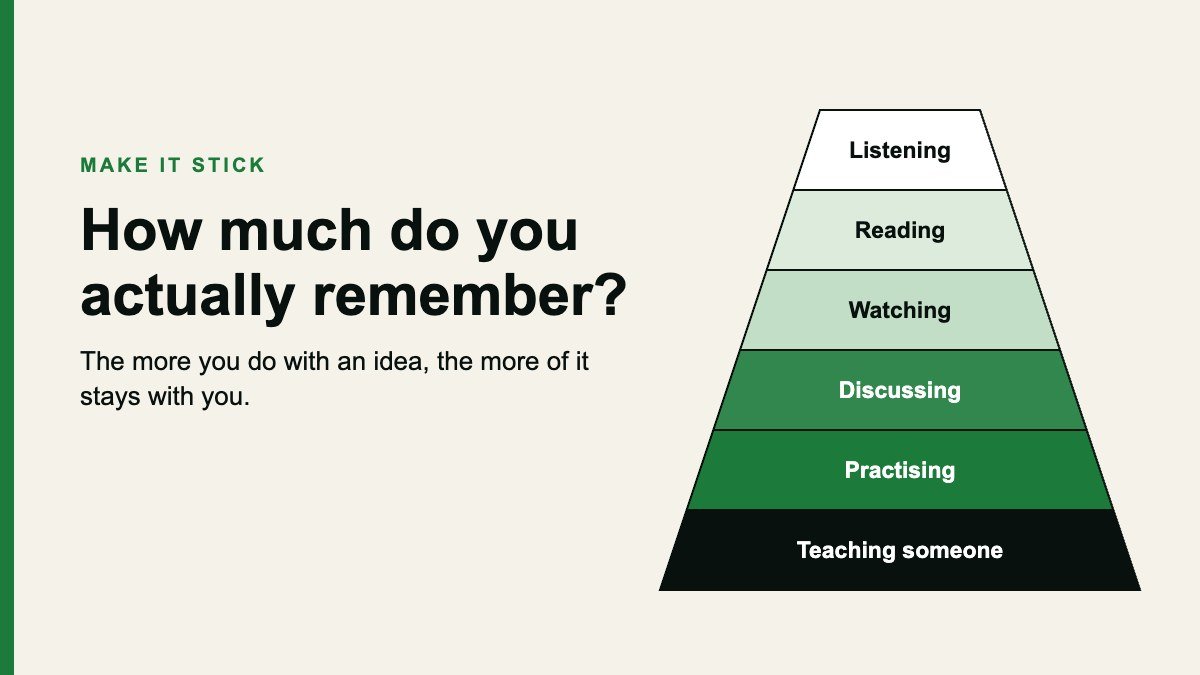
A diagram called the learning pyramid is shared widely online. It stacks ways of learning from passive at the top to active at the bottom, usually with percentages attached: a small number for lectures, ninety per cent for teaching others.
Those percentages have no study behind them. They have been passed around for decades without a source, and researchers who tried to trace them came up empty.
The shape still makes a fair point. Research on learning keeps finding that people remember more when they work with information rather than simply receive it. Testing yourself beats rereading. Spreading practice over several days beats cramming it into one. Explaining something to another person shows you quickly where your own understanding is thin.
Taking it in, or doing something with it
The top of the pyramid is listening, reading and watching. These are useful starting points, and most of what we consume never leaves them. A podcast on the school run, an article at lunch, a post saved before bed.
The bottom is discussing, practising and teaching. Here the idea has to be used. You have to put it in your own words, try it in your own week, or explain it well enough for someone else to follow.
If you are carrying work, home, family and everything in between, time spent reading advice is time you do not really have spare. Fifty saved posts you never use cost you more than three ideas you put to work.
Five ways to move an idea down the pyramid
- Write it in one sentence. Use your own words, not the author’s. If you cannot do it, read it again or let it go.
- Talk it through. Mention it to your partner, a colleague or a friend. Saying it out loud shows you whether it still makes sense.
- Try it within 48 hours. Keep it small. One change, on one day, is enough to learn whether it fits your life.
- Test yourself a few days later. Without looking, what was the idea? What happened when you tried it?
- Explain it to someone who could use it. Teaching is the strongest test there is. You will notice what you missed.
How this fits the Personal Reset
This is the Personal Reset applied to what you learn. Reflect on which ideas keep coming back to you. Prioritise one of them and let the rest wait. Act on it in a small, specific way. Then Re enter a week later and decide whether to keep it, adjust it or drop it.
Fewer ideas, properly used, will do more for you than a long list you meant to try.
Try this before the weekend
Think of the last genuinely useful thing you read or heard. Write it down in one sentence. Then choose one way to use it before Sunday.
If your week already feels too full to try anything new, start with When everything feels urgent, start here.

Written by Oz. I share practical ideas from years in business operations and project delivery, and from running a busy home. More about me.