
Practical productivity · 4 minute read
Most people who try a weekly review give up within a month. The usual reason is simple: the review they picked was built for someone with an empty Sunday and a love of spreadsheets.
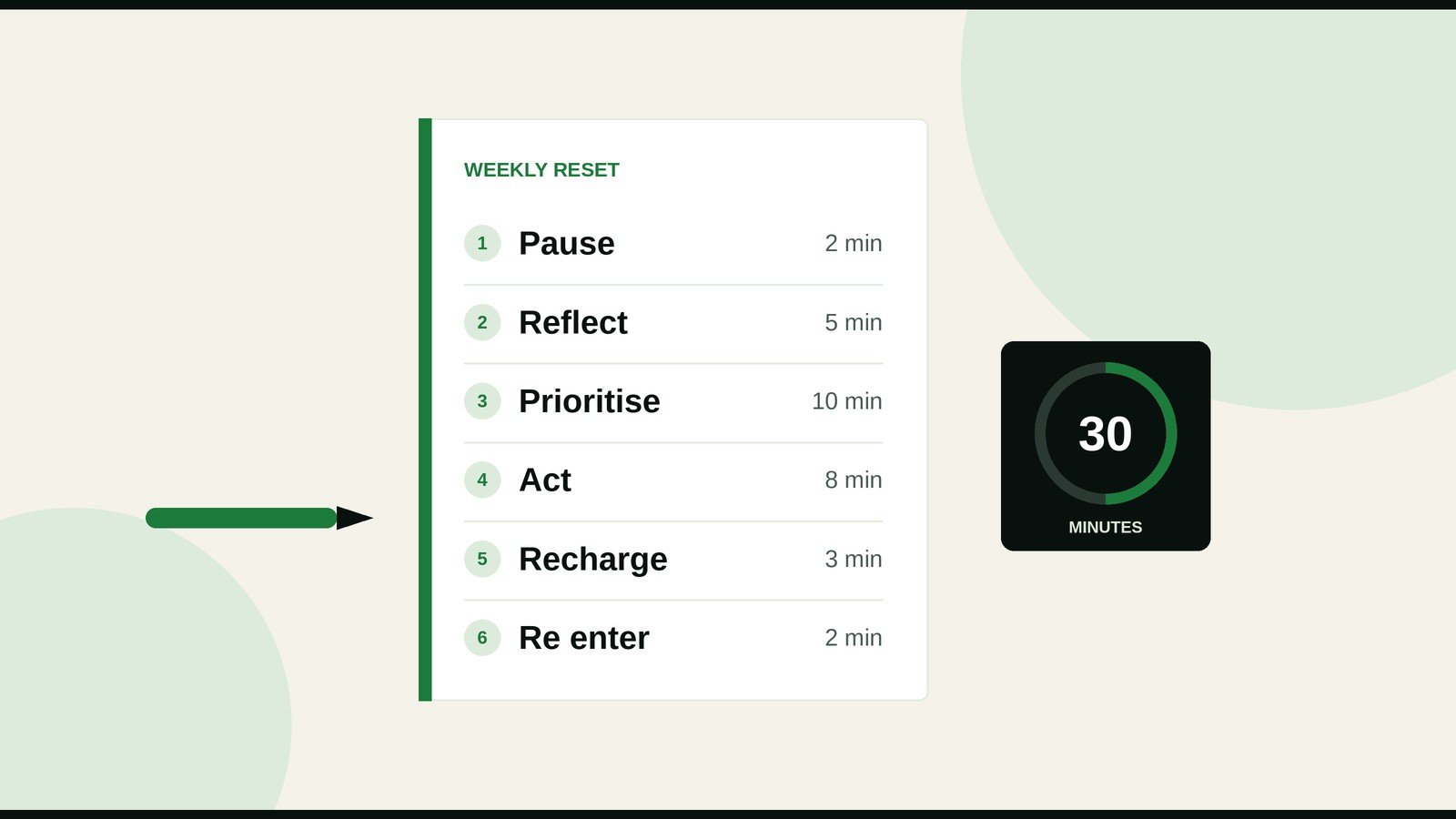
A weekly reset has 1 job. It gets you from the noise of last week to a clear start on Monday. If it takes longer than 30 minutes, you will skip it on exactly the weeks you need it most.
Here is a version built on the Personal Reset, broken into 6 short steps.
Before you start: pick a slot and protect it
Choose the same 30 minutes every week. Sunday evening, Friday afternoon or Monday before the inbox opens all work. What matters is that it sits in your calendar as a repeating event rather than a vague intention.
Bring 3 things: your calendar, your task list (wherever it lives) and something to write on.
1. Pause (2 minutes)
Stop adding. Close the inbox and messages. Take 2 minutes to notice how the week actually felt. Busy and productive are different things, and a quick honest check tells you how much to plan for next week.
2. Reflect (5 minutes)
Look back at last week’s calendar and list. Ask yourself:
- What got done?
- What slipped, and why?
- What took more time or energy than expected?
Write down 1 thing you learned. A single lesson is enough. You are looking for a pattern, not writing a report.
3. Prioritise (10 minutes)
This is the step that matters most. Get everything out of your head and onto the page: work, home, family and life admin. Then choose no more than 3 things that would make next week feel like progress.
Before anything new goes on the list, ask 3 questions:
- Does this need to happen this week? If not, give it a date and let it go for now.
- Is this actually mine to do? If not, hand it back.
- What will I stop to make room for it?
Your week has a fixed size. If you have chosen 3 priorities and 14 other things still feel urgent, read When everything feels urgent, start here.
4. Act (8 minutes)
A priority with no time attached rarely happens. Open next week’s calendar and give each of your 3 priorities a specific slot. Be realistic about meetings, school runs, training and the hours that disappear into life admin.
Then write down the very first step for Monday morning. Not the whole project, just the first 15 minutes of it.
5. Recharge (3 minutes)
Look at the week as a whole and ask where the rest is. If there is no gap anywhere, the plan will break by Wednesday. Book 1 thing that refills you: a walk, a class, an evening away from screens, time with people you like. Give it the same weight in your calendar as a meeting.
6. Re enter (2 minutes)
Read your 3 priorities and your Monday first step out loud, or tell someone at home. Then close the notebook. The point of a reset is to stop planning and start the week with a clear head.
When you miss a week
You will. Holidays, illness and weeks that fall apart happen to everyone. Do not try to catch up on 2 weeks at once. Do the shortest version instead: 3 priorities, 3 calendar slots, 1 first step. 10 minutes is far better than nothing, and it keeps the habit alive.
Make it yours
After 4 weeks, look at what you actually used. Drop the steps you skip every time and keep the ones that help. A 20 minute reset you keep beats a perfect one you abandon.
Which stage are you stuck in?
The short quiz shows which stage of the Personal Reset to start with.

Written by Oz. I share practical ideas from years in business operations and project delivery, and from running a busy home. More about me.