
Some days arrive already full. The inbox is busy, someone needs an answer by lunch, there is a form to sign, and the work you meant to do this week still has not moved.
On days like that, the problem is rarely effort. Every task is shouting at the same volume. When everything feels urgent, you end up doing whatever shouted last.
What I use on a full day is 4 boxes and 2 questions. It takes about 10 minutes, and it changes how the rest of the day goes.
The 2 questions
Ask these of every task on today’s list.
Is it urgent? Does it need doing today, or does something go wrong if it waits?
Does it matter? Does it move something you care about forward, at work or at home? Or does it mainly matter to someone else’s timing?
Be honest with the second question. Plenty of tasks feel important because they are loud, not because they count.
The 4 boxes
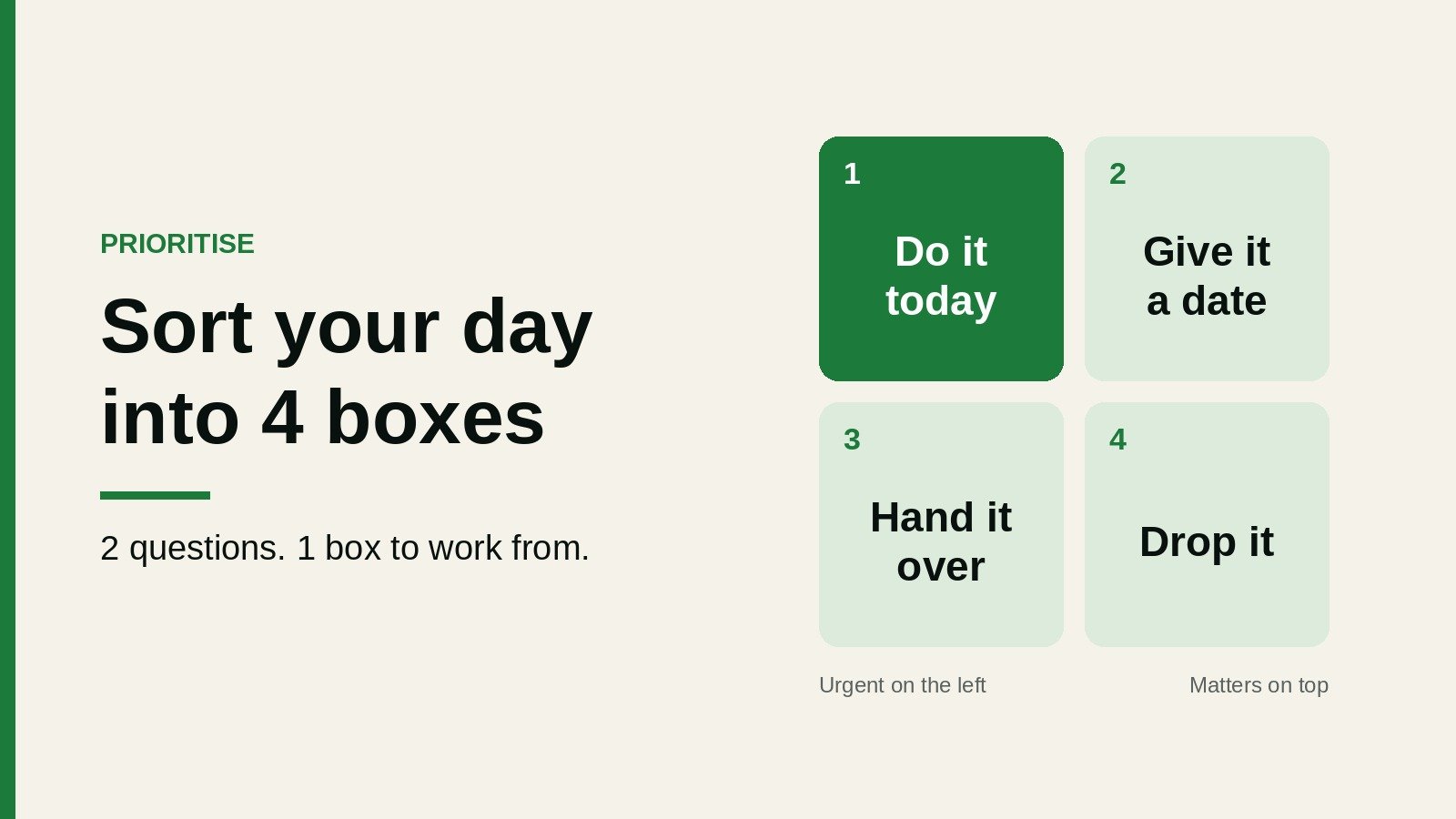
Your 2 answers put each task in 1 of 4 boxes. This is often called the Eisenhower Matrix.
- Urgent and important: do it today. The real deadline, the call that cannot wait, the problem that grows if you leave it.
- Important, not urgent: give it a date. The work that moves things forward. Planning, the health appointment, the project you keep pushing back. Nothing forces these today, which is exactly why they slip.
- Urgent, not important: hand it over. Someone needs it soon, but it does not need you. Ask a colleague, share it at home, reply with a polite no, or let a simpler version do.
- Neither: drop it. Cross it off. If it really matters later, it will come back.
Work from 1 box today
This is the part that makes it work. Today, you only work from the first box.
Everything else gets dealt with before you start, so it stops pulling at your attention. Box 2 tasks get a date in your calendar or on your list. Box 3 tasks get a message sent now, not later. Box 4 tasks get a line through them.
That is my rule on a full day. Only urgent and important work happens today. Everything else is scheduled, handed over or dropped the same day.
If box 1 still has 12 things in it, look again. Some of those are box 2 tasks that only feel urgent because they have been waiting so long.
Box 2 is where the progress is
It is tempting to see the 4 boxes as a way to get through urgent work faster. The real gain is box 2.
Box 2 tasks are the ones that, left alone, turn into next week’s emergencies. The report you could have started on Monday. The car service before the warning light comes on. Give each one a date and a small first step, and fewer things land in box 1 later.
A weekly reset is a good time to do this. A weekly reset you will actually keep shows a simple way to plan those dates in 30 minutes.
Where this fits in the Personal Reset
The Personal Reset has 6 stages: Pause, Reflect, Prioritise, Act, Recharge and Re enter. The 4 boxes belong in stage 3, Prioritise. That means choosing what matters now and deciding what can wait.
Sorting works best after Pause. If your tasks are spread across 5 places, you can only sort the ones you happen to remember. Start with the 10 minute gather, then sort the full list.
Try it tomorrow morning
Before you open your inbox, write down today’s tasks. Ask the 2 questions of each one and put a 1, 2, 3 or 4 next to it. Spend 5 minutes dealing with every 2, 3 and 4. Then start on your 1s.
Your next step
Sorting is stage 3. The free Personal Reset Checklist takes you through all 6 stages in about 30 minutes, with a pen and a clear order to work in. Keep it to hand for the next time your week feels full before it has even started.

Written by Oz. I share practical ideas from years in business operations and project delivery, and from running a busy home. More about me.